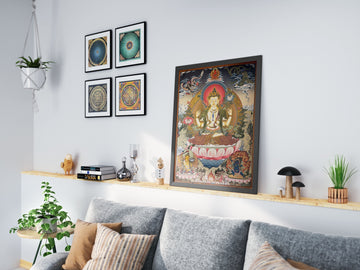
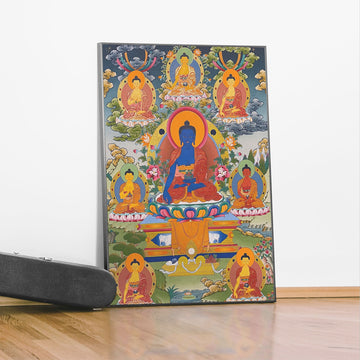
Chenrezig (Sanskrit Avalokiteshvara) is the bodhisattva of compassion, among the most loved figures in Tibetan Buddhism. His Tibetan name is usually explained as "the one who looks on all beings with eyes of compassion". His six-syllable mantra, Om Mani Padme Hum, is carved on stones, written on prayer flags and turned in prayer wheels across the Himalayas.
Four-armed Chenrezig
The most common form in thangkas:
- White, seated cross-legged on a lotus and moon disc.
- Two hands joined at his heart, holding a wish-fulfilling jewel: the wish to free all beings from suffering.
- His upper right hand holds a crystal rosary, one bead for each recitation of his mantra.
- His upper left hand holds a white lotus beside his shoulder, a sign of a pure mind.
- Silks and jewels of a bodhisattva, and often an antelope skin over his left shoulder.
Thousand-armed Chenrezig
In his most dramatic form, Chenrezig stands with eleven heads and a thousand arms, an eye in the palm of each hand, so that he can see and reach every being in need. The story goes that his head burst into pieces at the sheer scale of suffering, and Amitabha Buddha, his spiritual father, gave him new heads. Amitabha's red head sits at the top.
Lokeshwor in Nepal
In Nepal, forms of Avalokiteshvara are widely worshipped as Lokeshwor ("lord of the world"), and Newar painters often paint him within a mandala palace. Several of our larger mandalas show him at the centre.
In a painting
Chenrezig is often painted alone, or with Amitabha above him and other deities around him. Look for a gentle, even face, and a clear, crisp line in the hands and jewellery.