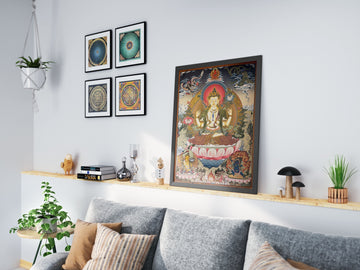
Green Tara is the female Buddha of enlightened activity, known above all for coming quickly to help. In Tibetan Buddhism she is called on in times of fear and danger, and she is one of the most loved figures in thangka painting.
How she is shown
- Green, the colour of activity, seated on a lotus and moon disc.
- Her left leg is folded, in meditation; her right leg is extended, the foot resting on a small lotus. She is ready to rise and help at once.
- Her right hand rests at her knee, palm open, in the gesture of giving.
- Her left hand is at her heart in the gesture of refuge, holding the stem of a blue lotus (utpala) that opens beside her shoulder.
- Silks, jewels and a crown, like a young princess, often with Amitabha Buddha above her.
Tara and the eight fears
Tara is traditionally said to protect from eight fears (lions, elephants, fire, snakes, thieves, imprisonment, floods and demons), which are also read as the inner dangers of pride, ignorance, anger, envy, wrong views, greed, attachment and doubt. Some thangkas show these rescues in small scenes around her.
The 21 Taras
A well-known prayer, the Praises to the Twenty-One Taras, describes 21 forms of Tara, each with her own colour and activity. Many paintings show Green Tara at the centre surrounded by the 21 Taras in rows of small figures.
Her mantra
Om Tare Tuttare Ture Soha, one of the most widely recited mantras in Tibetan Buddhism.
In a painting
Look at the poise of her extended leg and the gentle tilt of her head, the transparency of her silks, and the fine line of the lotus stem. Green Tara is a popular gift, and suits almost any room.