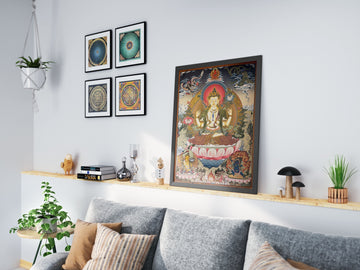
A mantra mandala is a mandala built from words. Instead of a palace or figures, its design is made of rings of sacred syllables, written in Tibetan or in the older Lantsa script, circling a single syllable at the centre.
What is a mantra?
A mantra is a short sacred formula, recited aloud or silently in meditation. Many are linked to a particular Buddha or bodhisattva. The best known is Om Mani Padme Hum, the six-syllable mantra of Chenrezig, the bodhisattva of compassion.
In Tibetan Buddhism, written mantras are treated with the same respect as spoken ones. A mantra mandala is a way of keeping them before the eye: in a shrine room, a meditation space or a home.
How to read one
- The centre: usually a single seed syllable, most often Om, sometimes on a lotus.
- The rings: concentric bands of mantras, each ring often holding a different prayer or the mantra of a different deity. They are usually read clockwise, the direction in which prayer wheels turn.
- The frame: rings of lotus petals, flames or vajras, and often a square border with patterned corners.
- The colours: many are painted in gold-coloured script on a black or deep blue ground, which makes the lettering glow; others use rings of colour.
The kinds on our site
- Mantra mandala: rings of mantras around a central syllable.
- Buddha mandala: mantra rings or a small palace with Buddhas or deities in roundels.
- Prayer mandala: the rings carry a specific prayer text.
- Dragon mantra mandala: mantra rings framed by dragons.
Mantra mandalas suit large, square spaces: ours range from about 55 × 55 cm to 110 × 110 cm. Because the design is symmetrical, they look balanced above a sofa, a bed or a meditation cushion.
What to look for
The finest mantra mandalas have even, crisp lettering of the same height all the way round, perfectly concentric rings, and fine detail in the borders. Zoom into the close-ups on each page to compare.