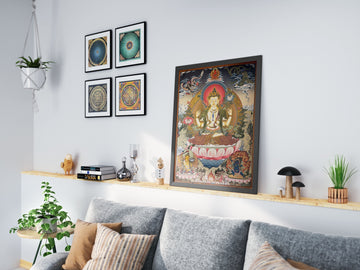
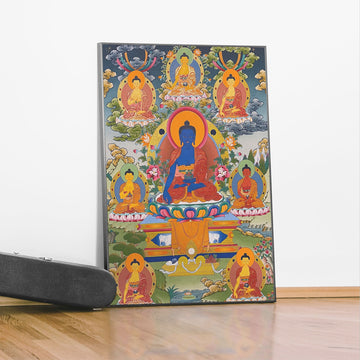
Choosing a thangka comes down to four questions: what it shows, how well it is painted, how big it should be, and where it will hang. This guide takes them in turn. It is written for first-time buyers, but collectors may find the section on quality useful too.
1. Start with the subject
A thangka is a religious painting first, and most people choose a subject that means something to them. Some of the most loved:
- Compassion: Chenrezig (Avalokiteshvara), and Green Tara, who is known for coming quickly to help.
- Wisdom: Manjushri, with his flaming sword that cuts through ignorance.
- Long life: White Tara and Amitayus.
- Healing: the blue Medicine Buddha.
- Generosity and wealth: Jambhala, holding a mongoose that spits jewels.
- The Buddha himself: Shakyamuni Buddha, or the Buddha Life Story, which shows the main events of his life around him.
- Teaching and reflection: the Wheel of Life, a map of how Buddhism explains the cycle of rebirth.
- Meditation and design: mandalas, from the intricate Kalachakra palace to simpler mantra mandalas.
If you are buying for someone else, Green Tara, White Tara, Chenrezig and Manjushri are popular choices that suit almost anyone. Each painting on our site has a short note on its subject in the "About this thangka" tab.
2. Look closely at the painting
Two thangkas of the same subject and size can differ in price twenty times over. The difference is in the painting itself. Zoom in on the photos and look at:
- The faces and hands of the main figure: calm, even eyes, and fingers drawn with care.
- The line work: thin, crisp, even outlines, including the gold-coloured ones on robes and jewellery.
- The shading: smooth blends in clouds, halos and robes, without blotches.
- The background: landscapes, flowers and small figures painted with the same care as the centre.
To make this easier, we grade every painting Classic, Fine, Master or Collector, and most pages show five close-ups (the four corners and the centre). How we grade and price explains what each grade means.
Hand-painted or printed? Printed thangkas exist, and some are sold as "hand-finished". A hand-painted thangka shows brush marks and tiny irregularities when you zoom in, and no two are identical. Every painting we sell is hand-painted.
3. Choose the size
Our sizes are the whole painting, including its painted border. Half the thangkas we have for sale are 66–85 cm on the long side, a size that works on most living-room walls. Our thangka size guide covers sizes, framing and brocade in more detail, and most pages show the painting to scale on a living-room wall.
4. Think about where it will hang
- Light: away from direct sun, which fades colours over time.
- Damp: away from bathrooms, kitchens and damp walls.
- Respect: many Buddhists hang a thangka at or above eye level, in a clean room, and never place it on the floor.
- Mounting: our paintings arrive unmounted and rolled. You can hang one as it is, frame it under glass, or have it mounted in traditional silk brocade.
Still unsure?
Tell us the room, the size of the wall and what draws you to thangkas, and we will suggest a few pieces. If a painting is not right when it arrives, you have 30 days from delivery to return it. Write to us: we reply within 24 hours.